The experienced IP Practice team along with the Litigation team of the firm provides comprehensive services related to IP Prosecution, lPR Litigation and Dispute Resolution.
A brief understanding of Intellectual Property Rights in India is as:
TRADEMARKS
A trademark or a brand name is a word, device, logo, sound, smell or a combination thereof that is used to distinguish the goods and services of one manufacturer or service provider from another manufacturer or service provider (Sec 2(zb)). Trademark law in India is well-settled and offers a robust protection and enforcement regime for right holders. The range of protection encompasses words, labels, devices, shapes, sounds, colors, textures, etc. amongst others.
Effects of Trademark registration:
Registration of a trademark in India is governed by Trade marks Act, 1999. A registered trade mark gives its proprietor the exclusive right to use the mark in relation to goods and services for which it is registered. A registered proprietor can enforce his rights against any person who uses an identical or deceptively similar mark in connection with the same or similar goods and services by instituting a suit for infringement and recovery of damages. An action for infringement, which is a statutory right, is dependent on the validity of the registration of the mark.
Registration Process
- Search:
- Filing of application
- Examination
- Hearing
- Publication
- Opposition
- Registration
- Renewal
There are five Trademark Offices in the cities of Ahmedabad, Chennai, Delhi, Kolkata and Mumbai respectively. The Intellectual Property Appellate Board (IPAB) is the appellate authority for adjudicating appeals against the orders of the Registrar of Trademarks and rectification (cancellation) petitions. We provide all the services related to the trademark registration and protection and having a robust knowledge of the field, we boast to be one of the cost effective upcoming firm in the Trademark Practice.

COPYRIGHT
Copyright is a right given by the law to creators of literary, dramatic, musical and artistic works and producers of cinematograph films and sound recordings. In fact, it is a bundle of rights including, inter alia, rights of reproduction, communication to the public, adaptation and translation of the work. There could be slight variations in the composition of the rights depending on the work.
Copyright is a right given to or derived from works / expression, and it does not protect ideas. The general principles of copyright are reflected in Art 27 of the Universal Declaration of Human Rights as below:
- Everyone has the right to freely participate in the cultural life of the community to enjoy its arts and to share its scientific advancement and benefits;
- Everyone has the right to protect its moral and material interests resulting from any scientific, literary or artistic production of which he is the author
The Indian Copyright Act recognizes copyright in:
- Literary,
- Artistic,
- Dramatic,
- Musical
- Cinematograph films, and
- Sound recordings
Why protection is necessary:
Copyright ensures certain minimum safeguards of the rights of authors over their creations, thereby protecting and rewarding creativity. Creativity being the keystone of progress, no civilized society can afford to ignore the basic requirement of encouraging the same. Economic and social development of a society is dependent on creativity. The protection provided by copyright to the efforts of writers, artists, designers, dramatists, musicians, architects and producers of sound recordings, cinematograph films and computer software, creates an atmosphere conducive to creativity, which induces them to create more and motivates others to create.
Process of registration of Copyrights in India
The Application for registration of copyright is to be made at the Copyright Office, New Delhi.
The process for getting a Copyright registration is as follows:
- Filing of application
- Issue of Diary No. / Application No
- Waiting period
- Objection to application
- Examination of application
- Hearing
- Registration
The firm’s services for copyright include copyright prosecution and registration, licensing and assignment, contract negotiation and drafting, due diligence, clearances and regulatory compliances, dispute resolution and enforcement. We also have created specialized teams for the copyright dispute resolution and litigation and have presence in various courts and forums for the matters dealing with the copyright.
Registration procedure:

PATENTS
The protection of patents in India is governed by Patents Act, 1970, and the Patent Rules, 2003. Patent gives the Patentee, the exclusive right to prevent others from making, using, selling, or importing the invention as defined in the claims of the patent application. There are two kinds of Patent protection provided in Indian i.e. Product Patent and Process Patent The exclusive rights acts as an incentive for innovation thereby encouraging research and innovation. Through these exclusive rights a patentee can control the activities of potential competitors and infringers in the country where the patent is in force.
Necessity to obtain a Patent for an invention:
An invention which is novel needs to be protected by the inventor in order to enjoy exclusive rights over the invention. If the inventor does not obtain patent rights for the invention and introduces the product/process based on the invention in the market, anybody can copy the invention and exploit it commercially. To debar others from using, selling, offering for sale or manufacturing the invention, the inventor must obtain a patent. The inventor can either exploit the patented invention himself/herself or can sell or license it to others for profit.
Criteria for Patentability:
In order to get a Patent for a new invention, it should fulfill the three necessary conditions:
- Novelty:
- Inventive step:
- Industrial applicability:
There are four Patent Offices in the cities of Chennai, Delhi, Kolkata and Mumbai respectively. The Intellectual Property Appellate Board (IPAB) is the appellate authority for adjudicating appeals against the orders of the Controller of Patents & Designs and revocation petitions.
We provide all the services related to the prosecution of the Patents as well as the commercialization and execution of Patents rights in India. The firm has a well established team to take care Patent litigation as well. The firm is also have professionals on its roll in order to provide the required services to obtain, maintain, and protect patent rights in India and take care of the specific business objectives of its clients in an increasingly competitive market.
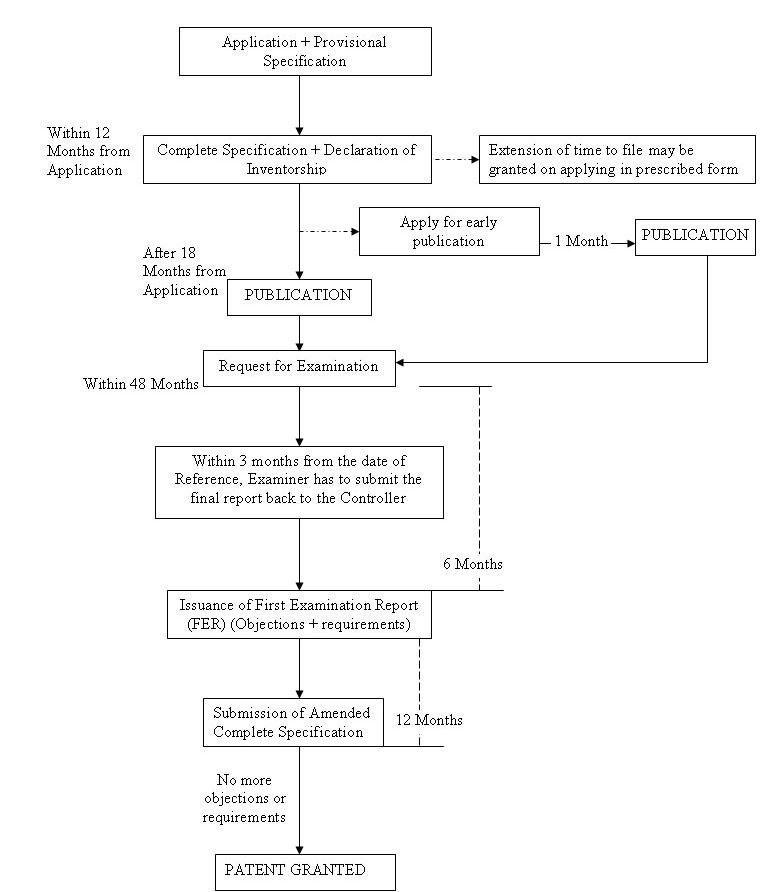
PROCEDURE FOR THE GRANT OF PATENTS IN INDIA
DESIGN
The Designs Act, 2000 defines a ‘Design’ as the features of shape, configuration, pattern, ornament or composition of lines or colors applied to any article whether in two dimensional or three dimensional or in both forms, by any industrial process or means, whether manual, mechanical or chemical, separate or combined, which in the finished article appeals to and are judged solely by the eye; but does not include any mode or principle of construction or anything which is in substance a mere mechanical device, and does not include any trade mark or property mark (Section2(d)).
Essential requirements for registration of design
- Should be new and original;
- Should not be disclosed in public in any way of publication whatsoever prior to filing date or the priority date of application;
- Should be distinguishable from known designs or combination of known designs;
- Should not be a mere mechanical contrivance;
- Should be applied to an article and novelty is judged only appeal to the eye;
- Should not be against public order or morality.
Objective of registration of designs for an Article
The objective behind the registration of a design under the Designs Act is to protect new or original designs so created to be applied or applicable to particular article to be manufactured by industrial process or means. Sometimes purchase of articles for use is influenced not only by their practical efficiency but also by their appearance. The important purpose of design registration is to see that the artisan, creator, originator of a design having aesthetic look is not deprived of his bona fide reward by others applying it to their goods.
The designs which are not eligible for registration under the Design Act
A design which
- is not new or original; or
- has been disclosed to the public anywhere in India or in any other country by publication in tangible form or by use in any other way prior to the filing date, or where applicable, the priority date of the application for registration; or
- is not significantly distinguishable from known designs or combination of known designs; or
- comprise or contains
DESIGN REGISTRATION PROCEDURE
- Application for registration of design:
- Examination:
- First examination report (FER):
- Reply to FER:
- Hearing:
- Registration of design
- Certificate of registration:
- Renewal:
We provide comprehensive services related to the Design Registration in India including Prosecution, Enforcement and Advisory services. We have an efficient team of professional having wide experience to handle design prosecution covering everything from industrial products, handicrafts, technical and medical instruments, watches and jewelry, houseware, electrical appliances, automotive products, etc.
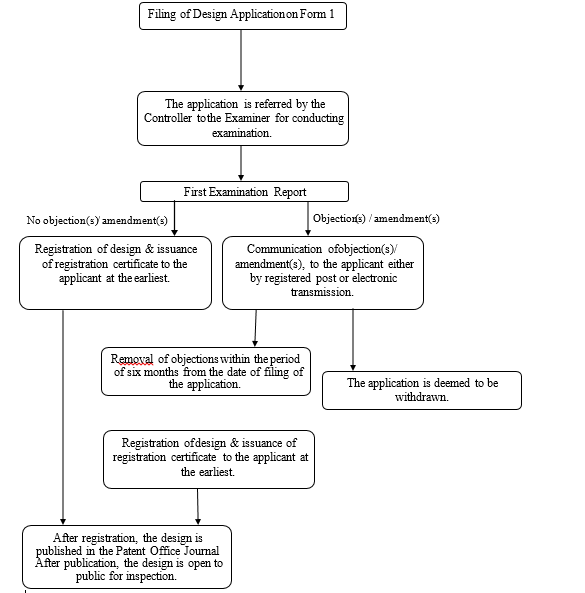
Flow chart of the procedure for registration of Design